Hi there, I'm Attila Blade, a huge fan of the DIY Stirling and hot air engines. You are currently on the Blade's World channel's blog.
I made a lot of experiments in the past 20 years from the beer can engines to a nicely machined desktop gadgets also I worked in professional projects worldwide.
You will find here DIY projects, homemade Stirling engine tutorials and interesting experiments, monthly as possible.
THX any help!
This is the second step of my huge project of thermoacoustic refrigeration.
Today I'll show you my new engine's parts also the first test run and I'll draw the conclusions.
The engine is a standing wave type refrigerator.
Base parts:
- loudspeaker driver
- heat exchangers
- stack
- resonator
- amplifier
- PC, program
- digital thermometers
That's all!
My 180/120 W SAL XPRO 2060 loudspeaker is working in a closed
20 litres 250 mm diameter orange PVC tube box.
The other PVC tubes are 50 mm outside diameter.
The fittings and other parts dedicated for this diameter.
Easy to use them.
The heat exchangers from 0,4 mm holes, 0,063 mm wire, 75% relative open area copper mesh.
I stick together these with neutral silicon on a sticky tape base.
Layer by layer, nearly hole on hole.
That was a horrible slow and riski work.
:)
The stack was a rolled, parallel plate style stack with 0,4 mm gap. Length: 83 mm
Plastic sheet's 0,08 mm thick.
I used a new tech for spacing!
Sorry, I don't need to show it yet!
I hope you understand! :)
But this technique is so different as sticked fishing line spacer.
It has more open area. :)
Amplifier is a KÖNIG 6000, 2x170W on 4 ohm.
Thermometers are HQ FT-10 stainless steel pin food thermometer,
the range of this thermometer is -50 to 300 C degrees.
The working frequency was 108 Hz,
sinus shaped wave
what I made with a small Hungarian language program they call it Jelgen.
So simple to use on any PC.
Resonator length was λ/2: 1,6 m
Experiment start at 22.7 degrees room temperature.
The hot side is going up pretty quikly, but after the cold side start to drop.
The cold side was loaded from the room across the copper heat exchanger,
so the 17 degrees is good for first run.
The hot side hasn't enough cooling capacity, so there was a big temperature different.
Here is my video about this experiment,
Dont forget to vote it, and share it with your friends on your community sites please!
Much better performance with a new parallel plate stack:
Conclusions: The cooling capacity isn't enough on the hot side, so I'll change the heat exchanger soon for a better one. After I want to reach the magic 0 degrees celsius! :) The stack performance was pretty good, but I need to change the length of it, also I need to change it for my new type parallel and pin array stack, and I need to check the differents in this atmospheric engine. Last performance on 27.05.2015. was only one degrees yet:
Later on... A need to build a "Bellow Bounce" type refrigerator too, but not the infold version as Ben and Jerry's refrigerator. My engine will be straight and I'll use a simple rubber boots accordion for bouncer. It has lower frequency and the resonator length should be 1/50th of the wavelength! Unbelievable thesis! See You Soon! BLADE
When I started to optimimise the original Manson engine that was in 2010. 03.
After I built my first hot side ventillation Manson engine with regenerator.
In 2012 I try to make a valveless Ericsson engine and then I had a Heureka feeling! :)
I crossed my two favorite engines in one.
I called it Kovács caloric engine. (as K.C.E.)
This engine has some typically Manson properties as simplicity, high torque, not much moving part, BETA formation, but the cycle is Ericsson caloric cycle.
The biggest different between the original Ericsson and my hybrid engine is the numbers of power strokes.
The original engine had one power stroke, when the heated gas expanded.
The other stroke was an exhaust stroke.
My engine has another one!:)
When the pressure dropped down in my engine then pull back the power piston.
So this is a pretty NEW engine!
My problem wasn't enough money for patent pending. But it is a "Who cares?" thing. I shared it, so if you can build one, just do it! :)
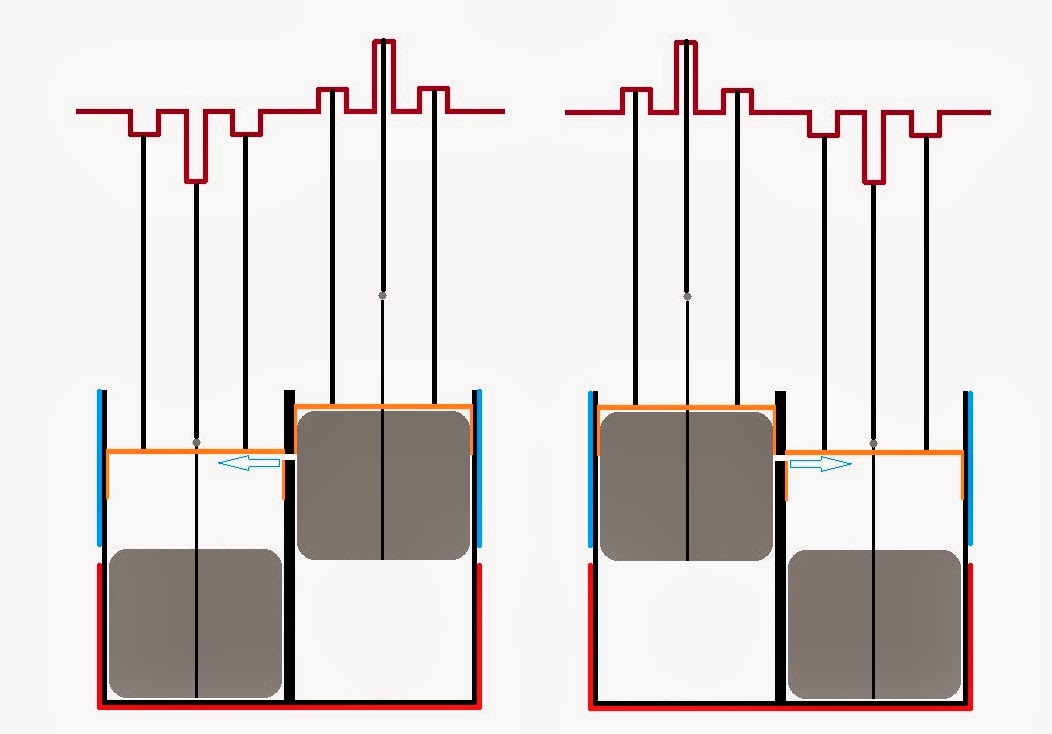
Simple drawing from the engine's two end points:
and an animated how does it works GIF:
I know these are just some schematic drawings, but the working method is simple.
This is an old idea from me, but now I had time to draw. :)
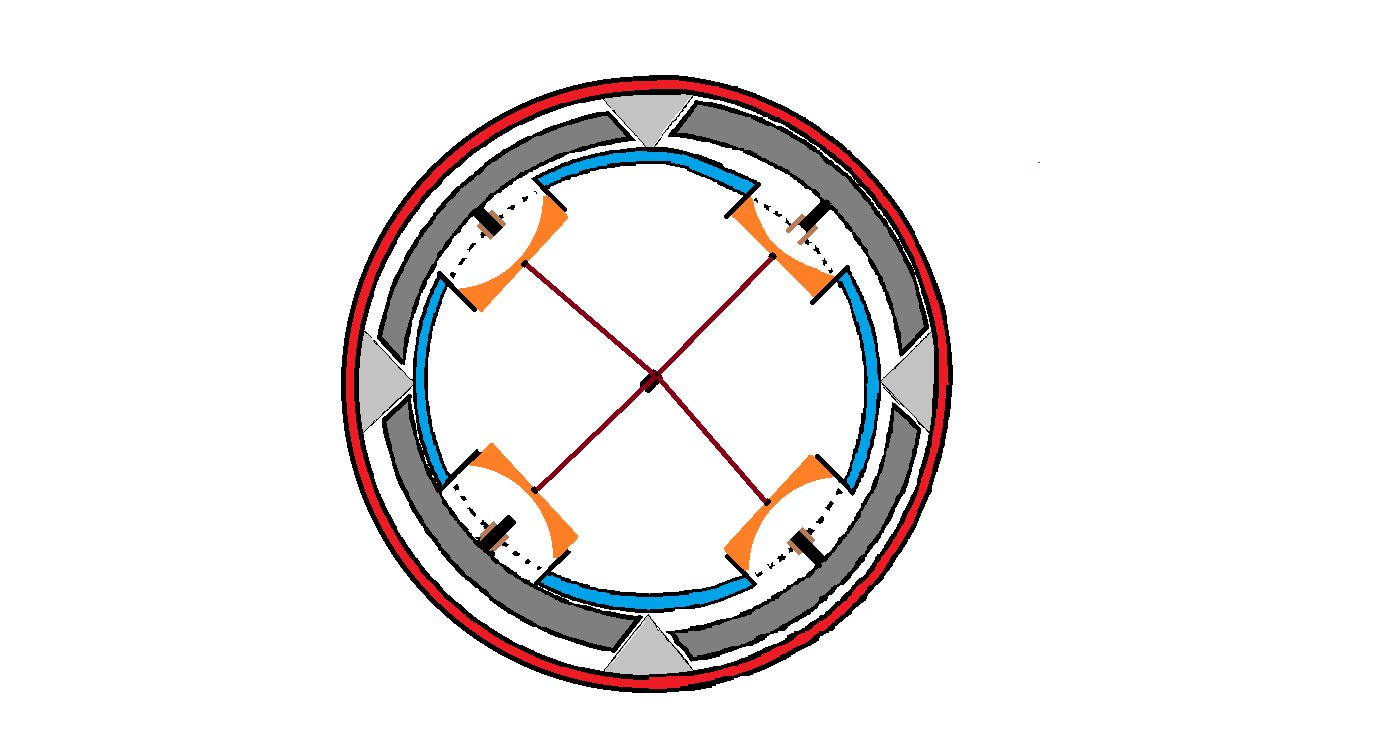
A simple top wieved picture from my LTD Ringbom type Stirling engine idea:
The LTD engines with usable electric energy output are huge constructions usually.
They follow the model constructions shape and I think it is a dead end.
Do you know the SunPulse engines?
Sunpulse engines diameter is 2m and the construction's height is nearly same 2m.
Usable hot surface is 3.14 m2
They use big power and displacer pistons.
The direct solar version use conical window to the sun, because the pressure changing can push/pull the material all the time, and this is waste energy if we use just a simple flat surface.
I knew another manufacturer in Germany, but that is not working yet.
That was the Sunmachine.
I saw there first the curved window LTD Stirling engine, and I liked that simple solution for this problem.
After I started to develope my version.
Step by step.
Day by day.
And the loop is closed:
HEUREKA!
Why not use cilindrical shape of this engine?
My IDEA's diameter only 1m, the height is 1m too, but the usable heat contact surface is 3.14 m2 as like SunPulse!!!
Not any huge parts, because inside I have 4 different engine.
These engines working as like twice-double acting Stirling engine.
The original Manson engine hasn't got regenerator, but a small gap between the displacer and the cylinder.
This is a bad regenerative parts, so I tried a simple regenerator in my first engine.
My first engines had hot side ventillation!
Remember, the original engines had cold side inward, and hot side outward breathing.
The Rupp engines had cold side ventillation without regenerator too.
What's the different?
The original engine get cold air from outside, no preheating!
It has slow and bad heat exchange, because the contact surface was small.
I used a steel tube for breathing. It was a preheater also a preregenerator.
The preheated air easier expand when the displacer-regenerator (secondary) move up.
The heat exchange's time shorter, the engine has higher speed, also performance.
The engine has 250 ccm volume, and it was very low budget construction!
Easy to build and so simple with only one self controlled valve.
I know it is useless for real power, but what can produce a professional one...?
Here is my little boy's firs run, on denatured alcohol burner: