Hi there, I'm Attila Blade, a huge fan of the DIY Stirling and hot air engines. You are currently on the Blade's World channel's blog.
I made a lot of experiments in the past 20 years from the beer can engines to a nicely machined desktop gadgets also I worked in professional projects worldwide.
You will find here DIY projects, homemade Stirling engine tutorials and interesting experiments, monthly as possible.
THX any help!
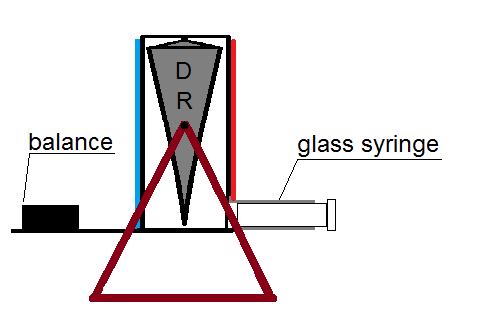
This is a real LTD heat engine, because the engine works with low temperature different!
The engine start at 3-5 degrees different!
My engine's working range is 27-31 C
The key of the operation is a heat sensitive material.
This material is pretty sensitive for heat.
If we have a curved one then after heated up that material will straight or even concave.
As you can see on this picture (FIG. 1), if you need to close a thermoacoustic standing wave engine, then the closed resonator part (right side) should be same length as left side, the sound generator base.
The whole system is a half wavelenght thermoacoustic engine.
The stack's center on the λ/8 exactly.
But what we can do with a mechanical resonator?
We can replace the whole resonator tube length( λ/4=4/8 of whole tube length) + the volume between the cold heat exchanger to the resonator tube ( λ/16= 1/8 length).
So what we can do?
We can replace the whole length 5/8th part.
That is nearly 2/3 of full length!
After we get a short engine like this:
Where the 104 is a buffer volume. This volume help for the gas flow going trough the 112 stack
also the 108-110 heat exchangers.
114 is the piston and the back side is a generator also "gas spring volume", or solid spring of course.
But
the next post will be very interesting for you! :)
My
friend Simi112's developed an engine what I called "Metronome".
The
engine had a good torque, and the frequency was so stable.
He
modified a water piston Ringbom engine.
The water piston is the power piston in a basic Ringbom constructions as you know. Simi112 changed the pistons, and created a big diameter piston to move the displacer, and a smaller one with water in a tube for phase changing. The engine works well! (check below the video) In March of 2014 I've seen an interesting engine on Dreisotech's youtube channel. He called it Very Simple High Frequency Engine (VSHFE). This engine is same as Metronome the only different is the phase changer piston, because the piston is air here. This construction is faster than the water piston version. When I showed the video to Simi112, we start to develope this construction and we found a little suprise there. The tube could be tune the engine's frequency also we can tune up the whole engine to a resonant frequency, where the amplitude is maximised, and the torque is great! So this engine is a moving displacer thermoacustic engine too! What??? How??? Is this possible? But the cycle is really changed! Not Stirling as in a Ringbom! The tube has a greater resistance than the power piston and the engine works closely as a Manson engine. The tube works like a gas-diode valve. It looks like a fully open engine, but when the pressure increase in the cylinder, then the gas push out the power piston first, and after can „wide open” the gas-diode.
When the "valve" is "opened", the gas piston start to move out with a great momentum and created a vacuumised cylinder after start to cool down the gas in the cylinder. When the inward phase coming and the gas diode "open" again then the gas piston create a pressurised section in the cylinder before the gas start to heat up! It is really interesting and strange. Because the power piston has an increased power under the whole strokes as like Manson!!! But when the "valve" is "open" then the gas piston pre-vacuumise, also pre-pressurise the cylinder in the working method.
The Manson has only pressure relief sections! So...we have an engine with Manson cycle (more or less) with a bigger working pressure intervall. I'll try to show you what I mean about the p-V diagram
I know you are really need to see my new designed Manson or KCE engines, but my life is so complicate actually, so I'm sorry about delay it will coming later a little bit.
But, my friend simi112 (YT nickname) started a series of thermoacoustic engines.
I followed his work and after we discussed the engines, working methods.
Anyway...here is my first designed traveling wave engine nearly Fellow's TAC generator.
Not perfect yet, but it was the second test run.
The design is so simple!
I made some pictures of assembly
As you can see I used first an aluminium tube for the hot side,
but the first test run finished with a big hole on this tube...:(
After I changed it for a stainless steel hotdog maker's tube.
When I started to optimimise the original Manson engine that was in 2010. 03.
After I built my first hot side ventillation Manson engine with regenerator.
In 2012 I try to make a valveless Ericsson engine and then I had a Heureka feeling! :)
I crossed my two favorite engines in one.
I called it Kovács caloric engine. (as K.C.E.)
This engine has some typically Manson properties as simplicity, high torque, not much moving part, BETA formation, but the cycle is Ericsson caloric cycle.
The biggest different between the original Ericsson and my hybrid engine is the numbers of power strokes.
The original engine had one power stroke, when the heated gas expanded.
The other stroke was an exhaust stroke.
My engine has another one!:)
When the pressure dropped down in my engine then pull back the power piston.
So this is a pretty NEW engine!
My problem wasn't enough money for patent pending. But it is a "Who cares?" thing. I shared it, so if you can build one, just do it! :)
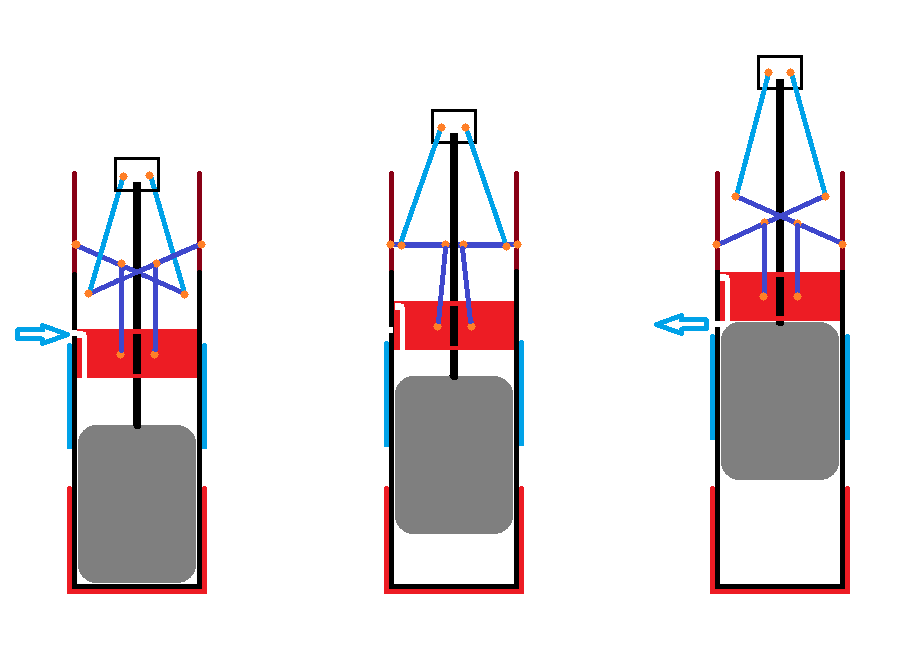
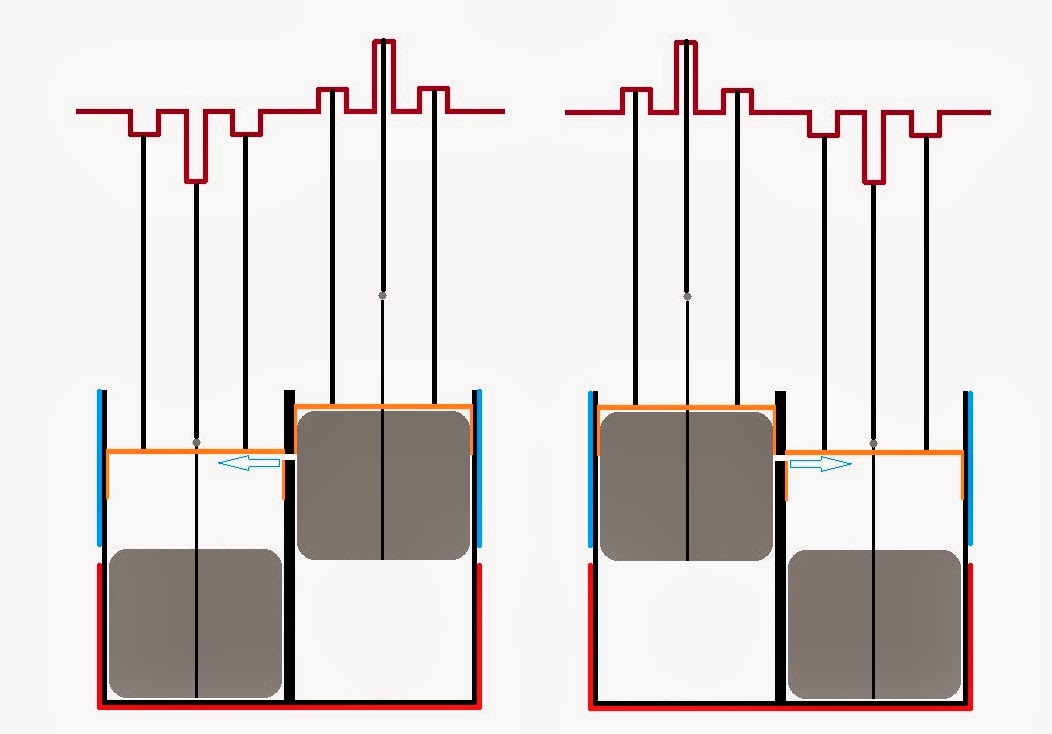
Simple drawing from the engine's two end points:
and an animated how does it works GIF:
I know these are just some schematic drawings, but the working method is simple.
This is an old idea from me, but now I had time to draw. :)
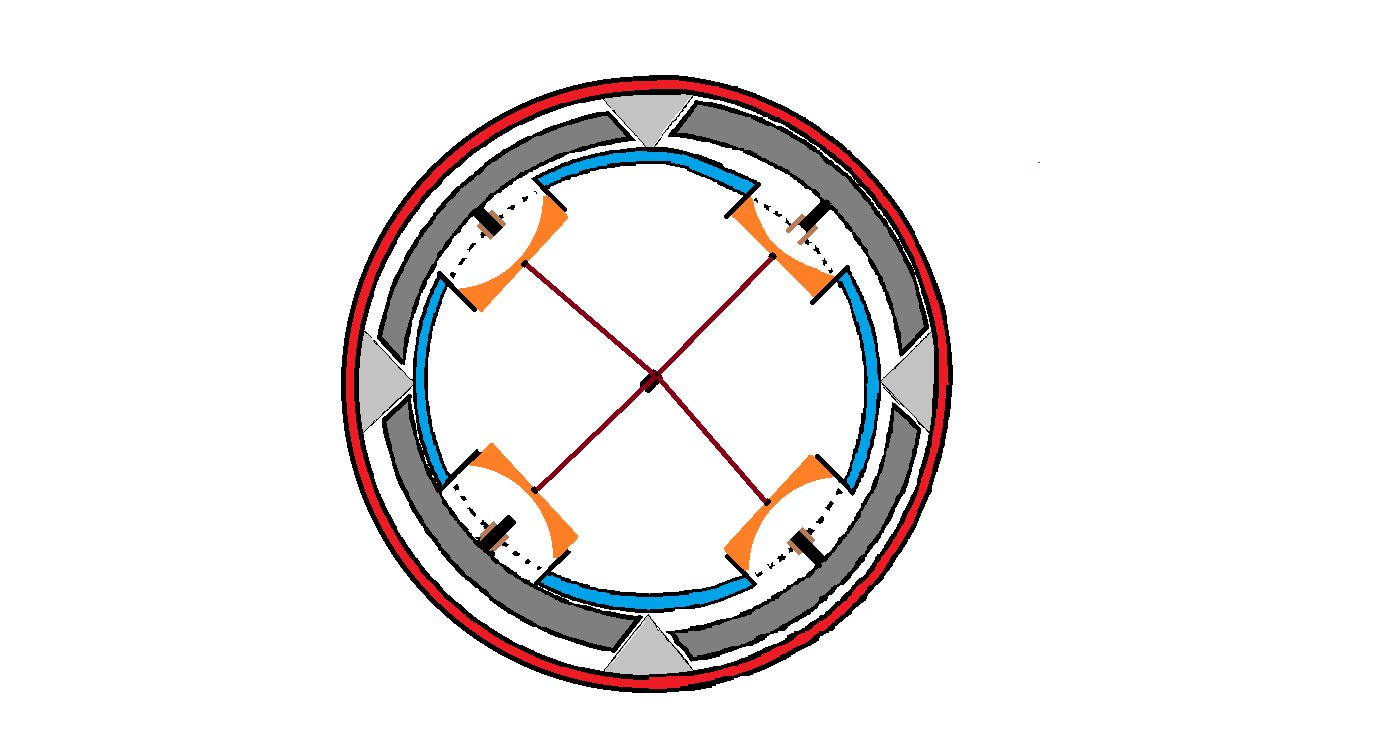
A simple top wieved picture from my LTD Ringbom type Stirling engine idea:
The LTD engines with usable electric energy output are huge constructions usually.
They follow the model constructions shape and I think it is a dead end.
Do you know the SunPulse engines?
Sunpulse engines diameter is 2m and the construction's height is nearly same 2m.
Usable hot surface is 3.14 m2
They use big power and displacer pistons.
The direct solar version use conical window to the sun, because the pressure changing can push/pull the material all the time, and this is waste energy if we use just a simple flat surface.
I knew another manufacturer in Germany, but that is not working yet.
That was the Sunmachine.
I saw there first the curved window LTD Stirling engine, and I liked that simple solution for this problem.
After I started to develope my version.
Step by step.
Day by day.
And the loop is closed:
HEUREKA!
Why not use cilindrical shape of this engine?
My IDEA's diameter only 1m, the height is 1m too, but the usable heat contact surface is 3.14 m2 as like SunPulse!!!
Not any huge parts, because inside I have 4 different engine.
These engines working as like twice-double acting Stirling engine.
The original Manson engine hasn't got regenerator, but a small gap between the displacer and the cylinder.
This is a bad regenerative parts, so I tried a simple regenerator in my first engine.
My first engines had hot side ventillation!
Remember, the original engines had cold side inward, and hot side outward breathing.
The Rupp engines had cold side ventillation without regenerator too.
What's the different?
The original engine get cold air from outside, no preheating!
It has slow and bad heat exchange, because the contact surface was small.
I used a steel tube for breathing. It was a preheater also a preregenerator.
The preheated air easier expand when the displacer-regenerator (secondary) move up.
The heat exchange's time shorter, the engine has higher speed, also performance.
The engine has 250 ccm volume, and it was very low budget construction!
Easy to build and so simple with only one self controlled valve.
I know it is useless for real power, but what can produce a professional one...?
Here is my little boy's firs run, on denatured alcohol burner: