Turn your Stirling engine into a car!

Hi there, BLADE is here again!

Today I'll show you a simple method, how you could turn your Stirling engine KIT
to a simple car if you want.

The car's basic is a nice little glass/aluminium body Stirling engine from

The original Stirling engine has a DC generator with bright LED stripes,
also it could work as a heat pump, if we use the DC generator as a driver motor.
I made few little interesting experiment with this KIT,
so check it out first:


After I've got some e-mail to create something different from the KIT.

I thought about a car.
But I haven't got any toy car wheels, 
so I made it!

The car has soft drink can wheels with rubber ring surface
for a smoother run.

The wheels are great for any other toy car projects too.
I made an instructional tutorial video about the wheels
and included into my Stirling Engine Toy Car video


If you want to buy a Stirling Engine KIT for you
I could give you a 10% coupon code!

Use my link here:
My exclusive coupon code for 10% discount: ED-BA

Special thanks to Engine DIY dot com
to support my efforts!



BLADE

Stirling Engine Generator "walking beam" alpha configuration premiere

Hey guys,
I've got a glossy,
well made, high speed Stirling Engine Generator
what I've been tested in the past few days.
It was amazing!

The walking beam part's
made from brass.
The whole engine preciously fabricated with cnc machine.

Preview I.
Buy your walking beam Stirling engine generator with an exclusive deal here:
Your -10% coupon code: ED-BA

 I measured the RPM of the engine
it was much faster than I thought first.
Between 2000-2500 was the average RPM, 
but sometimes it could run on 3250 RPM.
(no wind, I used burner heat trap)

The engine has graphite coated pyrex glass pistons for the good sliding and sealing performance.
The unit has good compression ratio.
The pistones are moves freely as possible with small
under 15mm stroke.

Preview II.
Buy your walking beam Stirling engine generator with an exclusive deal here:
Your -10% coupon code: ED-BA

The main cylinder was made from pyrex tube with 16 mm outer diameter.
The displacer piston made from a glass syringe's piston directly
with our cutted part of a glass cylinder
what they put into the aluminium radiator part with silicone O rings.

The stands are stainless steel rods fixed with SS material bolts.
We have a nice glass alcohol burner with eloxed aluminium cup
also we have a side fixed DC generator
what we could
connect to the engine with a rubber ring
also we could use some blinking LEDs.

These are quiet beautifully indicate the small generator's power.

I made a PREMIERE video 
where I show you the unboxing process with some slow motion videos:

Premiere:

If you want to buy your walking beam Stirling engine generator with my exclusive deal just click the link below:
Your -10% coupon code: ED-BA

See You Soon!

BLADE
Collaboration with EngineDIY.com

Hey guys,
BLADE is here again!
Today I wanna show you my new friendly cooperation
with a heat engine-desktop toy manufacturer

They was founded in 2009 for retailing different type of heat engine models in China only.
Few years later they are opened the borders
and they turned business to international e-commerce services.

Picture from: EngineDIY.com


EngineDIY.com has a brilliant collection of heat engines.
Simple and multicylinder HTDs, LTD type Stirling engines


Image not recovered: 7868ef53-ab93-42be-85fa-e70b6830989b_704x704.jpg

Pictures from: EngineDIY.com

vacuum or flame lickers

Image not recovered: 4152bf1f-f563-4002-a0c3-b035803d10a8_704x704.jpg
Picture from: EngineDIY.com

steam engines

Image not recovered: 31a453ab-762c-4cc2-860a-39752cefef8a_704x704.jpg

and other type but interesting engines 
not only for school projects
:)

Picture from: EngineDIY.com

They have nicely machined and designed desktop toys.

I've got a cast molded base all-metal HTD Stirling engine KIT
few weeks ago from 

I made a nice premiere video.
Check this out!


If you want to build one for yourself
here is the link for this engine: http://bit.ly/2diyengine

Assembling video for this engine:


Thanks for your attention!
See You Soon!
BLADE


Magnetic propulsion drive LTD Stirling

Hi folks!

I made a little LTD Stirling engine with my open source magnetic drive system.
The mechanism works perfectly!

The engine could run fast as a JAXA Stirling,
but actually I created  some mistakes in the construction yet.
The cylinder and the glass piston was sticky somehow!
And the piston movement was limited too.
Anyway...
but the engine started with these bad parameters too!

This gives enormous power to continue my work on my way!
I won give up!

Here is a little video below.

Support my efforts with a simple video sharing, or link sharing on your community site please!


Magnetic Propulsion Drived Stirling Engine (Video)

Hi folks!

Do you remember my very old Stirling engine driving method?


YEP!

Last weekend I found an old but short video from my first prototype 
magnetic propulsion drived HTD Stirling engine.

That was a big suprise, 
I didn't remember any video from this engine!
:)
But here it is!

It was a bad construction, but it worked 4 full stroke and two other. :)
The engine wasn't cooled, so it wasn't a big suprise.


Share this video, and the driving method too
because it is an open source project!
Non patented driving mechanism!

And I believe the Butterfly effect 
also 
the 100th monkey theorys!

My older post HERE.

See You Soon!
BLADE

My new LTD Stirling with this driving mechanism!
HERE!

Thermoacoustic refrigeration part 2.

Hi folks!

This is the second step of my huge project of thermoacoustic refrigeration.
Today I'll show you my new engine's parts also the first test run and I'll draw the conclusions.

The engine is a standing wave type refrigerator.
Base parts:
- loudspeaker driver
- heat exchangers
- stack
- resonator
- amplifier
- PC, program
- digital thermometers
That's all!

My 180/120 W SAL XPRO 2060 loudspeaker is working in a closed
20 litres 250 mm diameter orange PVC tube box.


The other PVC tubes are 50 mm outside diameter.
The fittings and other parts dedicated for this diameter.
Easy to use them.

The heat exchangers from 0,4 mm holes, 0,063 mm wire, 75% relative open area copper mesh.
I stick together these with neutral silicon on a sticky tape base.
Layer by layer, nearly hole on hole.
That was a horrible slow and riski work.
:)


The stack was a rolled, parallel plate style stack with 0,4 mm gap. Length: 83 mm
Plastic sheet's 0,08 mm thick.


I used a new tech for spacing!
Sorry, I don't need to show it yet!
I hope you understand! :)
But this  technique is so different as sticked fishing line spacer.
It has more open area. :)

Amplifier is a KÖNIG 6000, 2x170W on 4 ohm.

Thermometers are HQ FT-10 stainless steel pin food thermometer,
the range of this thermometer is -50 to 300 C degrees.

The working frequency was 108 Hz,
sinus shaped wave
what I made with a small Hungarian language program they call it Jelgen.
So simple to use on any PC.

Resonator length was λ/2: 1,6 m

Experiment start at 22.7 degrees room temperature.
The hot side is going up pretty quikly, but after the cold side start to drop.
The cold side was loaded from the room across the copper heat exchanger,
 so the 17 degrees is good for first run.
The hot side hasn't enough cooling capacity, so there was a big temperature different.
Here is my video about this experiment,
Dont forget to vote it, and share it with your friends on your community sites please!


Much better performance with a new parallel plate stack:


Conclusions:

The cooling capacity isn't enough on the hot side, so I'll change the heat exchanger soon for a better one.
After I want to reach the magic 0 degrees celsius!
:)
The stack performance was pretty good, but I need to change the length of it, 
also I need to change it for my new type parallel and pin array stack, 
and I need to check the differents in this atmospheric engine.

Last performance on 27.05.2015. was only one degrees yet:


Later on...
A need to build a "Bellow Bounce" type refrigerator too, but not the infold version as Ben and Jerry's refrigerator.
My engine will be straight and I'll use a simple rubber boots accordion for bouncer.
It has lower frequency and the resonator length should be 1/50th of the wavelength!
Unbelievable thesis!

See You Soon!
BLADE


1300 Subscribers on YT! THANKS!!! :)

Thanks very much to everyone, who subscribed my channel
watched and shared my videos
or followed my blog.

Only one word:
!THANKS!

Special thanks to Didier Desbordes who
supported my work on pay-pal!!!

I ordered some staff for my next project:


Thermoacoustic refrigeration part 1.

New project first video.

Simple construction, without resonator tube.
Not any wavelength calculation for length of tube, or buffer volume.
This is an ALPHA type free piston (!) heat pump with Stirling cycle in the stack!
That is all what I need to write to you actually.


Standing wave thermoacoustic engine with mechanical resonator

What is the mechanical resonator?

This is a simple solid piston with adjustable spring, or back buffer volume.
The mechanical resonator can replace the acoustic resonator easily.
"Simulation calculations show that the mechanical resonator dissipates 40 % less 
acoustic power than the acoustic one." 

Wouw! :)

How we can make one?
So simple but
some basic information first.

As you can see on this picture (FIG. 1), if you need to close a thermoacoustic standing wave engine, then the closed resonator part (right side) should be same length as left side, the sound generator base.
The whole system is a half wavelenght thermoacoustic engine.
The stack's center on the λ/8 exactly.

But what we can do with a mechanical resonator?
We can replace the whole resonator tube length( λ/4=4/8 of whole tube length) +  the volume between the cold heat exchanger to the resonator tube ( λ/16= 1/8 length).
So what we can do?
We can replace the whole length 5/8th part.
That is nearly 2/3 of full length!
After we get a short engine like this:

Where the 104 is a buffer volume. This volume help for the gas flow going trough the 112 stack
 also the 108-110 heat exchangers.
114 is the piston and the back side is a generator also "gas spring volume", or solid spring of course.

http://www.google.de/patents/US6578364

OK!
We know "everything" to make a simple TAMR.
:)

I made a short DIY video for you how do you make your first model from ordinary materials.


After I made another model from a big diameter test tube and accordion piston.
That was so speedy, strong and simple of course.


The engines frequency was lower than original because the weight/spring tension was different.
Not optimal, but the engines are works with an enough frequency for me.
:)
I hope you enjoyed!
Please share and vote my videos and subscribe my Youtube channel.
See you soon!
BLADE


Manson engine's modified as "Metronome"

Hi guys!

I start to make a new engine from my old Manson fan engine on the last weekend.
It was really rusty and it looks like something scrap there.
But the engine base was pretty good condition!
I was lucky!
:)

I took off the fan, also the crank and rod.
Cutted off the tube where was the valve originally.

After I connected to the pipe a 62 cm long
ID: 7 mm tube.
It was the load for the "Metronome" effect.
Do you remember for my earlier post?
Ok!
There is the working method.

Anyway...the engine works well.
The torque is pretty good 
and if I can change the tube with a spiral silicone tube 
then it will be much more compact. 

I need to make a cold side ventillation version
because then the engine could cooling down himself.
And later I can pressurise it!
:)


A weird hot air engine: "Metronome"


My new working office is so busy...sorry!
But the next post will be very interesting for you! :)

My friend Simi112's developed an engine what I called "Metronome".
The engine had a good torque, and the frequency was so stable.


He modified a water piston Ringbom engine.
The water piston is the power piston in a basic Ringbom constructions as you know.

Simi112 changed the pistons, and created a big diameter piston to move the displacer, 
and a smaller one with water in a tube for phase changing.
The engine works well!
(check below the video)

In March of 2014 I've seen an interesting engine on Dreisotech's youtube channel.
He called it Very Simple High Frequency Engine (VSHFE).
This engine is same as Metronome the only different is the phase changer piston,
 because the piston is air here.
This construction is faster than the water piston version.
When I showed the video to Simi112, we start to develope this construction
and we found a little suprise there.
The tube could be tune the engine's frequency
also we can tune up the whole engine to a resonant frequency,
where the amplitude is maximised, and the torque is great!
So this engine is a moving displacer thermoacustic engine too!
What???
How???
Is this possible?

But the cycle is really changed!
Not Stirling as in a Ringbom!

The tube has a greater resistance than the power piston and the engine works closely as a Manson engine.
The tube works like a gas-diode valve.
It looks like a fully open engine, but when the pressure increase in the cylinder, then the gas push out the power piston first, and after can „wide open” the gas-diode.

When the "valve" is "opened", the gas piston  start to move out with a great momentum and created a vacuumised cylinder after start to cool down the gas in the cylinder.
When the inward phase coming and the gas diode "open" again 
then the gas piston create a pressurised section in the cylinder before the gas start to heat up!

It is really interesting and strange.
Because the power piston has an increased power under the whole strokes as like Manson!!!
But when the "valve" is "open" 
then the gas piston pre-vacuumise, also pre-pressurise the cylinder in the working method.

The Manson has only pressure relief sections!

So...we have an engine with Manson cycle (more or less) with a bigger working pressure intervall.

I'll try to show you what I mean about the p-V diagram


Is it real?
What do you mean?

I created a video what's happening in the engine:


My friend Simi112/ Metronome Heat Engine
made videos from his experiments.

Please share this informations!
I hope somebody can help me about the engines p-V diagram,
because I'm not pretty shure in.
It looks like a new thermodinamical cycle
and a NEW hot air engine construction.


See you soon!

BLADE


Rhombic drive VS. My 105° "L" yoke drive system

Hello guys!

It has long been thinking about a solution what modelling the rhombic-drive movement, 
without any complicated manufacturing.

I was sure it's possible!

First I changed the Ross yoke mechanism.
"T" to "L"
:)
Such an interesting alphabetical magic!

After I calculated the shafts positions, and the angles.
Next step was I made a rhombic drive in Solid Works 3D
and saved 90 frames/sec pictures.
I created my mechanism in same frame rated.
Here is the solution how I can see the similar thing also the different things
about this two methods.

If you interested my work click on my youtube channel.

Here is the latest movie, where I can show you this two drive mechanism in a video.
I changed the angle of my "L" shaped yoke last time 90 to 105 degrees,
because the phase angles was better.

What do you think about it?

Thermoacoustic traveling wave engine

I know you are really need to see my new designed Manson or KCE engines, but my life is so complicate actually, so I'm sorry about delay it will coming later a little bit.

But, my friend simi112 (YT nickname) started a series of thermoacoustic engines.
I followed his work and after we discussed the engines, working methods.
Anyway...here is my first designed traveling wave engine nearly Fellow's TAC generator.


Not perfect yet, but it was the second test run.
The design is so simple!


I made some pictures of assembly


As you can see I used first an aluminium tube for the hot side, 
but the first test run finished with a big hole on this tube...:(
After I changed it for a stainless steel hotdog maker's tube.

I'll show you How it's works?! on my next video!
See you soon!
Blade


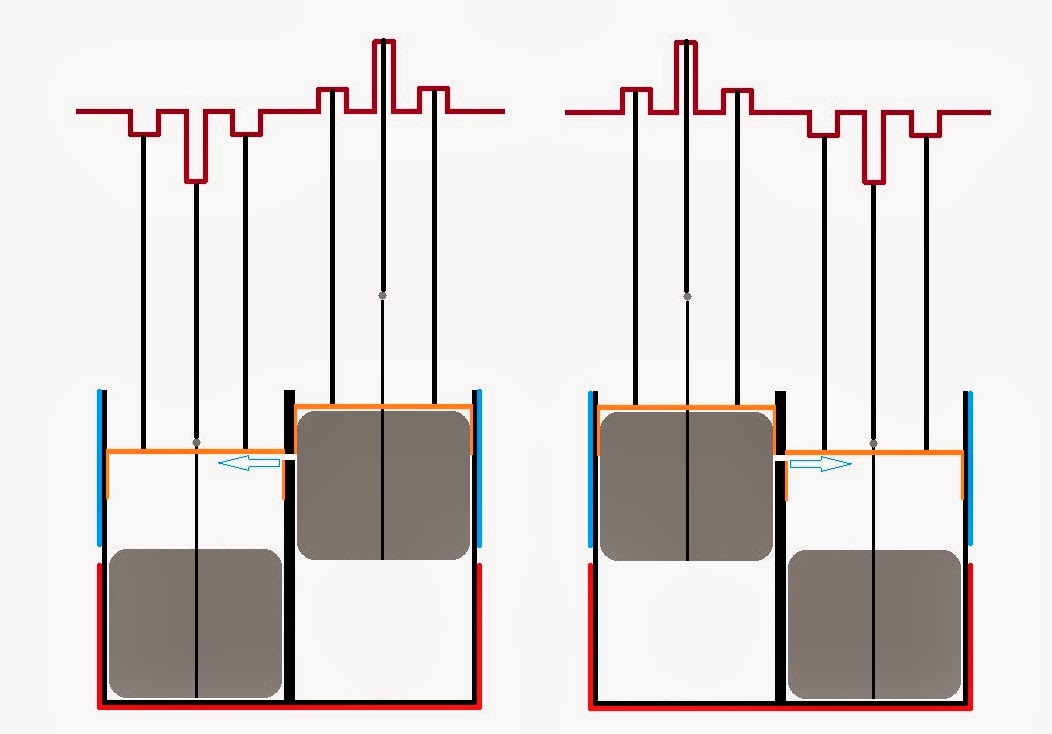
Teeter, table seesaw Stirling engines

Simple engines for home design, or relax time.

Self-balanced water piston design


Solid piston design with adjustable balance weight


Rotary Manson ( my old ideas)

Hi all,
here is my new post from my old ideas about rotary type Manson engine.
All engines are on my photobucket profile few years ago, but I share these ideas here now.

Closed cycle regenerative rota-Manson with hot side ventillation:
V 2.0 with tube in tube rotary valve:

Tandem type hot side ventillation rota-Manson engine:
Original cycle rota-Manson engine with inside crankshaft (water pump):


Happy New Year!


New drive control units for my beta type Manson engine

Hello guys!

Two weeks yet and I'll start to build my double cylinder, closed air cycle, beta type Manson engine 
in Transylvania.
Woohoo! :)
I'm so excited!

I had thought about the driving system of this engine this entire weekend, and the conclusion was that it would be made with excentric drive.
But I also developed a new "teeter" drive mechanism for an another beta type Manson engine.

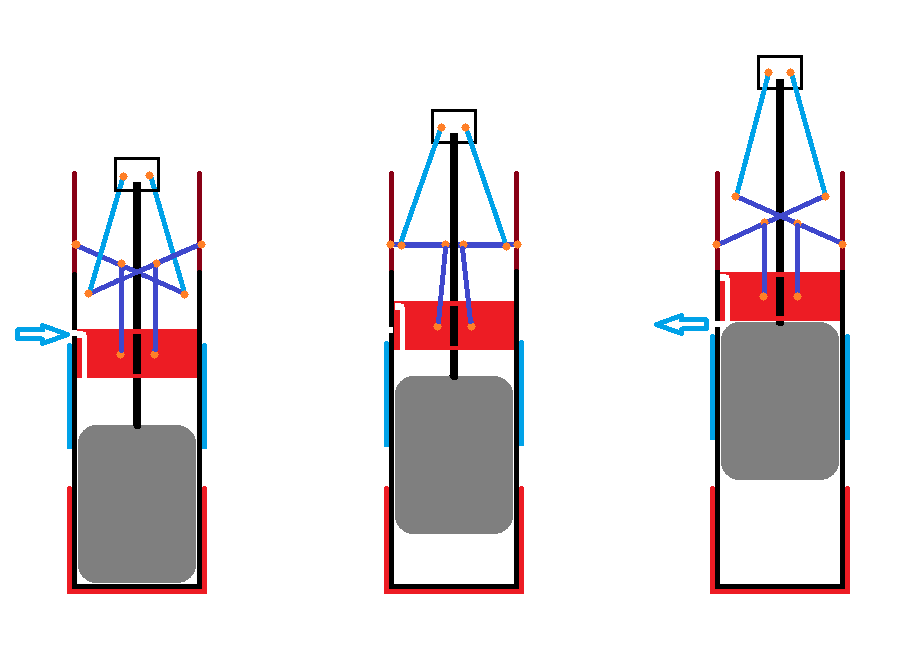
I made for you an animated GIF about this drive control unit:


Also here is my other vision the X-drive mechanism especially for my Manson engines:


And another one...
:)
This is a 3D animation what I made with SolidWorks professional.
I'm a beginner and this is my first animated assembly, 
but you can check how does it work.
I used a simple drive unit, it is pretty nice.


Manson/Ericsson hybrid (Kovács caloric engine)

When I started to optimimise the original Manson engine that was in 2010. 03.
After I built my first hot side ventillation Manson engine with regenerator.
In 2012 I try to make a valveless Ericsson engine and then I had a Heureka feeling! :)
I crossed my two favorite engines in one. 

I called it Kovács caloric engine. (as K.C.E.)

This engine has some typically Manson properties as simplicity, high torque, not much moving part, BETA formation, but the cycle is Ericsson caloric cycle. 
The biggest different between the original Ericsson and my hybrid engine is the numbers of power strokes.
The original engine had one power stroke, when the heated gas expanded.
The other stroke was an exhaust stroke.

My engine has another one!:)
When the pressure dropped down in my engine then pull back the power piston. 
So this is a pretty NEW engine!

My problem wasn't enough money for patent pending.
But it is a "Who cares?" thing.
I shared it, so if you can build one, just do it!
:)

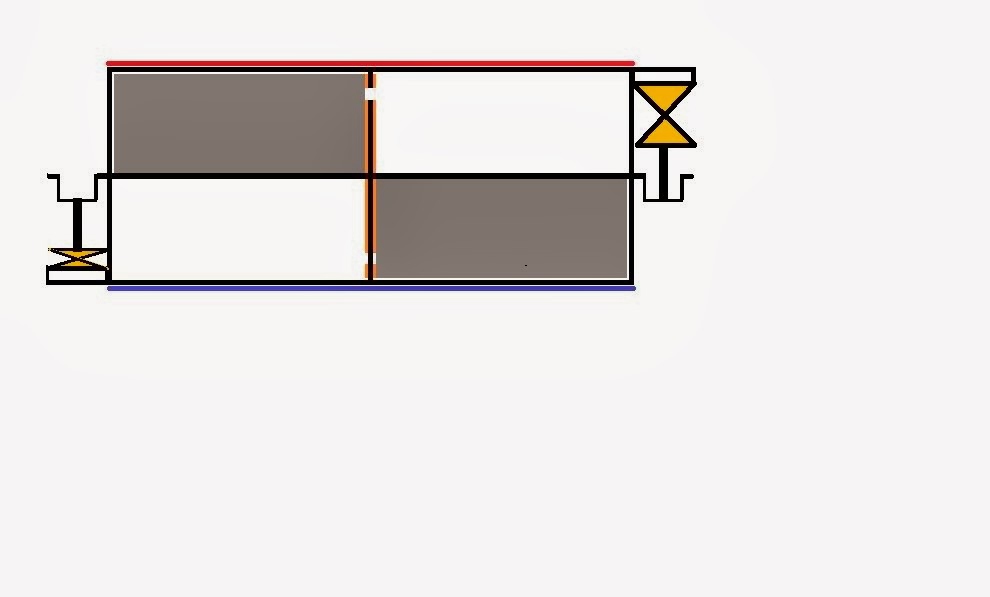
Simple drawing from the engine's two end points:

and an animated how does it works GIF:

I know these are just some schematic drawings, but the working method is simple.
I hope you understand it perfectly.


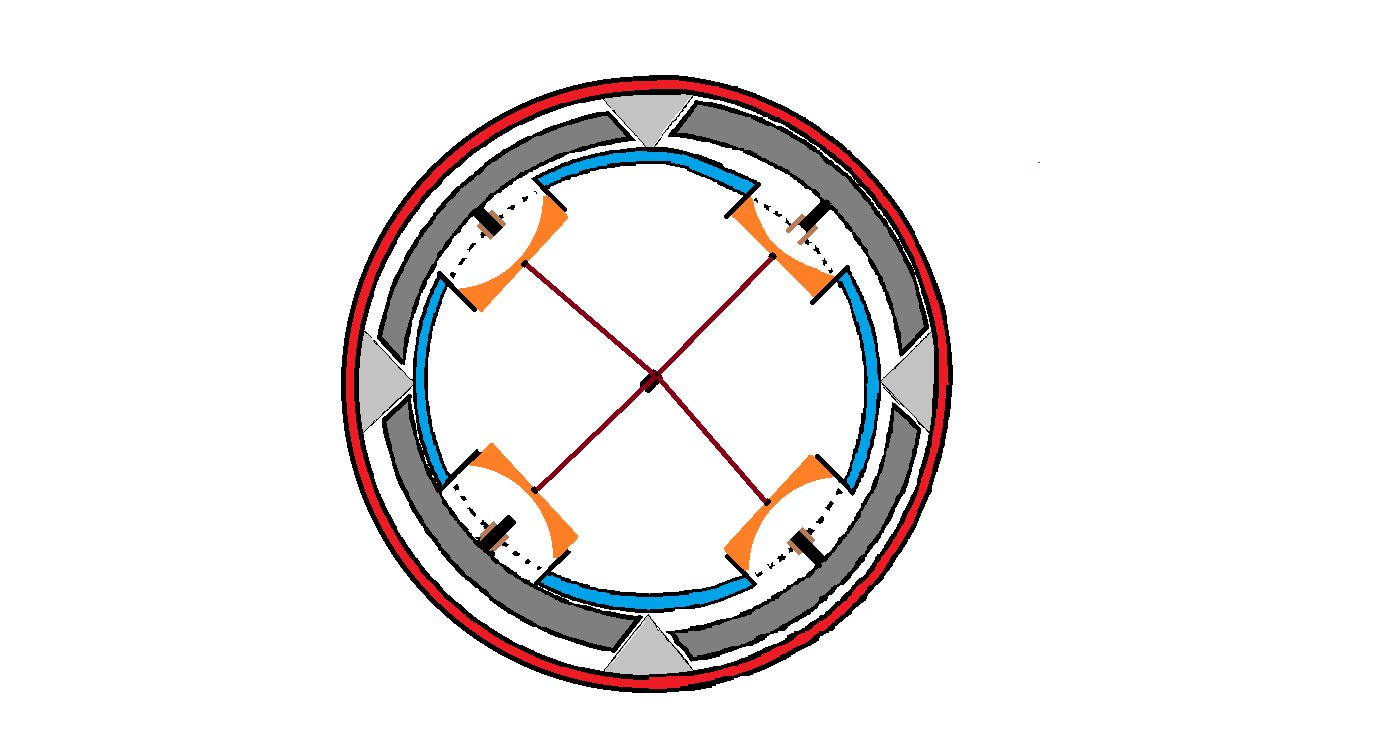
Ringbom type big volume LTD Stirling engine

This is an old idea from me, but now I had time to draw. :)


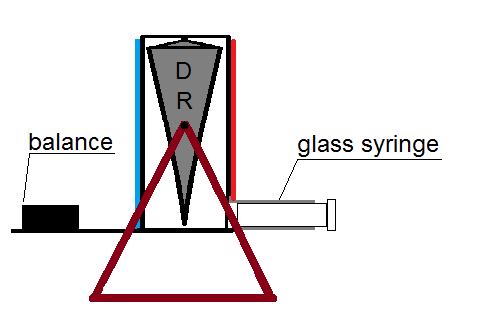
A simple top wieved picture from my LTD Ringbom type Stirling engine idea:

The LTD engines with usable electric energy output are huge constructions usually.
They follow the model constructions shape and I think it is a dead end.

Do you know the SunPulse engines?
Sunpulse engines diameter is 2m and the construction's height is nearly same 2m.
Usable hot surface is 3.14 m2
They use big power and displacer pistons.
The direct solar version use conical window to the sun, because the pressure changing can push/pull the material all the time, and this is waste energy if we use just a simple flat surface.

I knew another manufacturer in Germany, but that is not working yet.
That was the Sunmachine.
I saw there first the curved window LTD Stirling engine, and I liked that simple solution for this problem.
After I started to develope my version.
Step by step.
Day by day.
And the loop is closed:
HEUREKA!

Why not use cilindrical shape of this engine?
My IDEA's diameter only 1m, the height is 1m too, but the usable heat contact surface is 3.14 m2 as like SunPulse!!!

Not any huge parts, because inside I have 4 different engine.
These engines working as like twice-double acting Stirling engine.

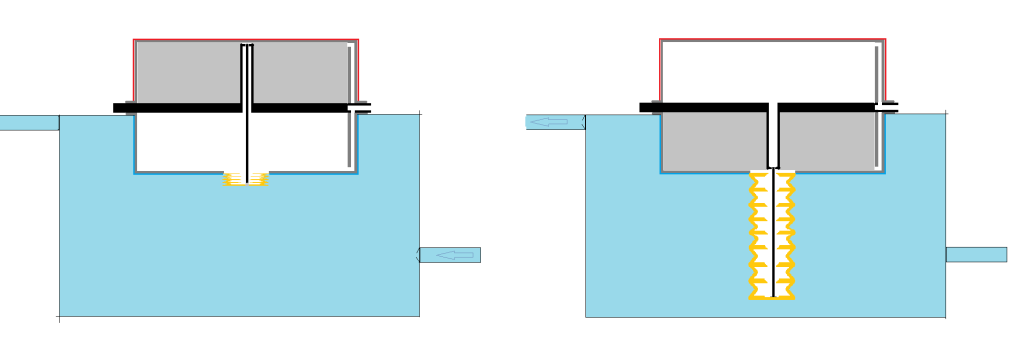
Animated GIF:


Exhaust gas recycling (double acting)

Next step: How we can use the exhaust gas for a good performance engine?

I created a double acting cold side ventillation closed cycle Kovács type Manson engine with normal crankshaft.
The engine will be faster and stronger!


Possible to use hot side ventillation too.